Have you seen a spotted lanternfly? Here’s what to know about the risk and what to do if you see one.
Have you seen a spotted lanternfly? Here’s all you need to know about the risk the bug poses to our agriculture.
More Stories



The spotted lanternfly is an invasive planthopper native to China, India, and Vietnam. It is also established in South Korea, Japan and the U.S.
The bug represents a threat to the tri-state environment, residential areas, and agriculture - particularly forests, orchards, vineyards, and nurseries, according to the Connecticut Agricultural Experiment Station.
Below is all you need to know about the insects.
Why is it important to stop a spotted lanternfly invasion?
The insect has the potential to greatly impact agricultural crops and hardwood trees. It feeds on the plant sap of many different plants including grapevines, maples, black walnut, and other important plants in the tri-state area. The bug feeding damage significantly stresses the plants, which can lead to decreased health and potentially death. While it does not harm humans or animals, it can reduce the quality of life for people living in heavily infested areas.
Where was it first discovered in the United States?
According to the New Jersey Department of Agriculture, it was first discovered in the U.S. in Pennsylvania in 2014, and has spread to other states, including Connecticut, New Jersey, New York, Delaware, Maryland, Virginia, West Virginia, and Ohio.
Has the pest been seen in the tri-state?
Yes. New Jersey populations were first detected in 2018 and have been detected in every county since, although populations remain most troublesome in the counties bordering Pennsylvania. The insects have been detected in Connecticut with established populations detected in Fairfield County and single individuals intercepted in numerous towns. And in New York, an infestation was discovered in Staten Island in August 2020.
In the spring of 2023, Long Island vineyard and orchard owners were concerned about how the invasive spotted lanternfly could affect crops on the East End. Watch the video below to see how one vineyard was doing to protect their crop:
The plant-eating pests are also a concern in Connecticut. State entomologist Dr. Victoria Smith said the the bugs can be a real nuisance because they can multiply rather quickly. Watch the video below to learn more:
The Westchester County Parks Department announced that it was taking new steps to reduce the spotted lanternfly population. It would use high-powered vacuums, non-toxic sprays and conservation dogs. Learn more about the efforts to fight the pests below:
In 2022, a lab at the New Jersey State Police Headquarters in Ewing was doing research on how to combat the invasive bug wreaking havoc across the state. Watch the video below to learn more about the research:
Check out the photos below from viewers who found lanternflies in the tri-state area. And scroll down to send us your photos:
How do you identify it?
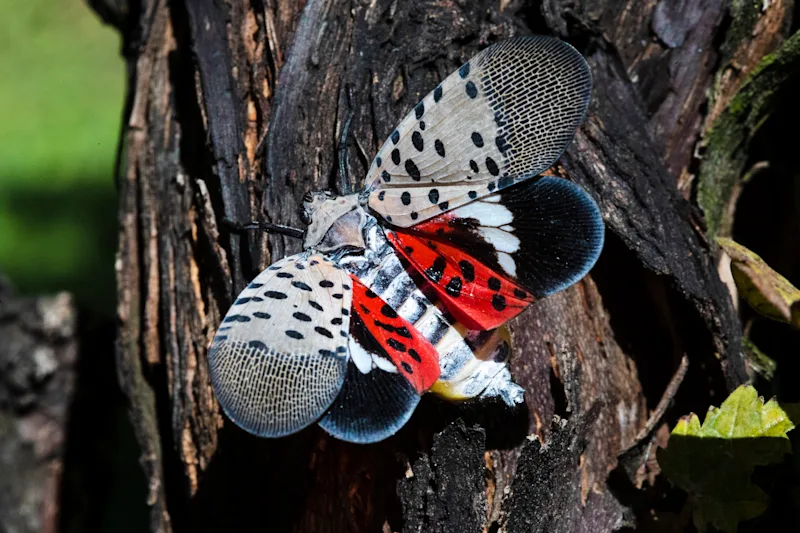
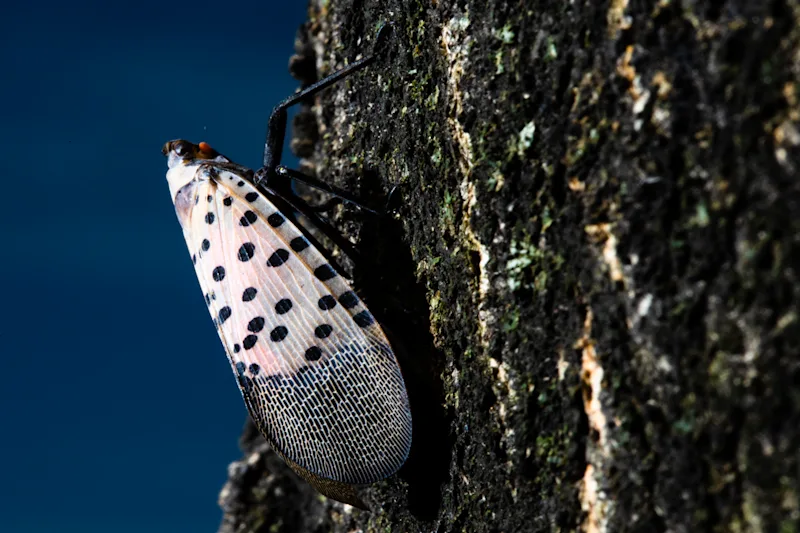
Adult spotted lanternflies are about one inch long and one half inch wide. The forewings are tan with black spots, while their signature colorful hindwings have lower red patches and upper black patches, separated with a white section in between. The red hindwings are mostly hidden unless the wings are spread. Adults crawl, jump, or fly short distances. You will see adults from July to November.
Spotted lanternfly eggs hatch in the spring and early summer. Early instar nymphs are black in color with white spots; fourth instar nymphs are red with black and white spots. You will see nymphs from April to October.

The spotted lanternfly eggs masses are laid on practically any surface including trees, stones, trash cans, side of a house, etc. during the fall. Egg masses are yellowish-brown in color, and most are covered with a gray, waxy coating prior to hatching. They may appear wet or sticky when fresh. You will see eggs from September to May. See more information and images here.
What are the signs of an infestation?
Sap oozing or weeping from tiny open wounds on tree trunks, which appears wet and may give off fermented odors.
One-inch-long egg masses that are brownish-gray, waxy and mud-like when new. Old egg masses are brown and scaly.
Massive honeydew build-up under plants, sometimes with black sooty mold.
What should you do if you see a spotted lanternfly?
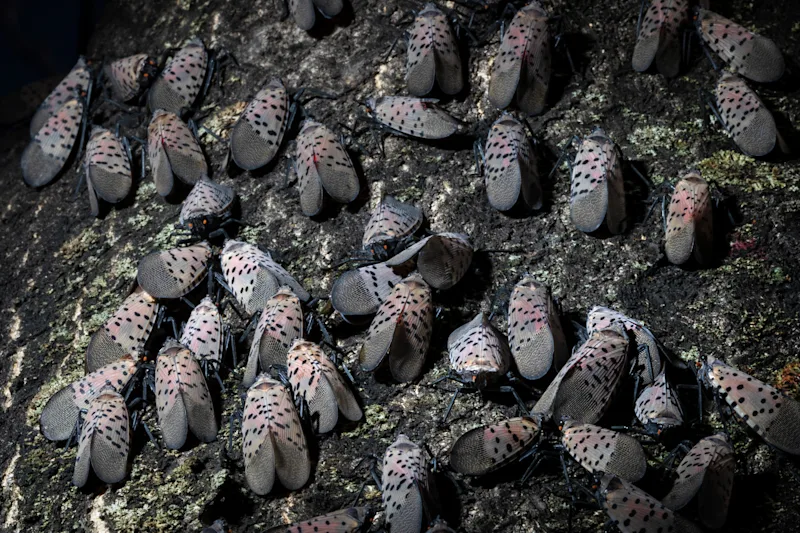
If you see one, state authorities say you should kill them before they lay eggs around October and November. Then report the sighting.
Who should you report sightings to?
The public is urged to report potential sightings of this invasive pest. If you suspect you have found a spotted lanternfly, snap a picture of it and report it to your state using the links below
Email: ReportSLF@ct.gov
Email: spottedlanternfly@agriculture.ny.gov
Want to learn more about the invasive pest in each state? Click the links below:
The Connecticut Agricultural Experiment Station
New Jersey Department of Agriculture
New York Department of Environmental Conservation
Did you see a spotted lanternfly? Submit your photo using the form below: