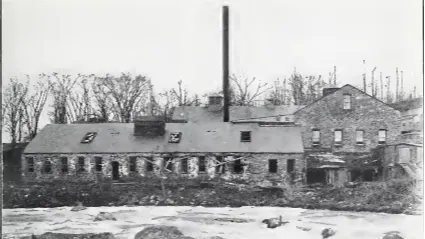
The historical New Jersey village that disappeared beneath a reservoir
More than a century ago, Old Boonton was cleared to supply drinking water to Jersey City. Its history includes Revolutionary War ironworks, a reported connection to George Washington and remnants that resurfaced decades later.
More Stories


Beneath the waters of a Morris County reservoir lies the former site of a community whose roots predate the American Revolution.
Old Boonton once stood along the Rockaway River, about 1 1/2 miles downstream from the present-day Town of Boonton. It had homes, farms, mills and an industrial history connected to the nation's founding.
But it wasn't destroyed by a flood or other natural disaster.
More than a century ago, the community's remaining buildings were demolished or moved, its roads abandoned and its landscape was intentionally flooded to supply drinking water to Jersey City.
A growing city needed water
By 1900, Jersey City had more than 206,000 residents and was a major industrial and transportation center.
Providing safe drinking water had become a serious problem.
Engineer Edlow Wingate Harrison, writing in 1909, described the Passaic River water supply as increasingly affected by upstream sewage and development, along with worsening water quality and concerns about typhoid fever.
Jersey City spent years seeking a dependable alternative.
In 1899, it contracted for a new system drawing from the Rockaway River watershed in Morris County. The project would carry water through an aqueduct to Jersey City in Hudson County, more than 20 miles away.
But creating the reservoir required clearing land occupied by a much older settlement.
A community older than the country
Old Boonton developed around ironmaking in the 1700s. A New Jersey historical marker erected in 1964 says the ironworks produced ordnance, or military supplies, for the Patriot Army during the Revolutionary War.
Among the community's prominent figures were ironmasters Samuel Ogden and John Jacob Faesch. One landmark was the Ogden-Faesch mansion.
A local legend states that George Washington visited the mansion during the Revolution.
Local historian Isaac S. Lyon recorded the story in an 1873 history of Boonton but acknowledged that he had not found an authenticated contemporary account confirming the visits.
Old Boonton's decline began long before the reservoir was built.
During the 1800s, ironmaking shifted toward Boonton Falls, about 1 1/2 miles upstream. A new industrial community developed there and eventually became the present-day Town of Boonton.
The original settlement was already being called Old Boonton decades before the reservoir project. It still contained homes and other properties when the project began.
Clearing Old Boonton
The Jersey City Water Supply Company acquired properties throughout the reservoir basin.
Some buildings were demolished. Others were relocated.
The Borough of Mountain Lakes says the McNeill House, built in Old Boonton in 1803, was moved to Mountain Lakes in 1900.
Morris County also sold its poorhouse property for the project. Research by the North Jersey History and Genealogy Center published by Morristown Green says the county received $30,000 and had 15 months to relocate the institution's residents.
The Town of Boonton's historical account says roads were among the features cleared from the reservoir basin.
A September 1902 report in The Boonton Times described properties sold to the water company and buildings destined for demolition. The surviving records do not establish how every resident felt about leaving.
A deadly job beneath the water
By 1904, water had begun covering the former settlement, but work on the reservoir's water-supply equipment continued.
On April 11, 1904, professional diver William Hoar descended into the reservoir to work on a gate valve at the dam.
Contemporary newspaper accounts later compiled by the North Jersey History and Genealogy Center say suction trapped him about 70 feet underwater as workers continued pumping air into his diving equipment and struggled to free him. Other divers joined the rescue effort, but Hoar died.
His ordeal drew newspaper coverage beyond New Jersey, illustrating the dangers of completing the massive waterworks project.
Water from the Boonton system began reaching Jersey City in May 1904.
When Old Boonton reappeared
The water concealed Old Boonton, but it did not erase every trace.
According to the Town of Boonton's historical account, crews cleared the reservoir basin of buildings, roads and trees as the project progressed, leaving behind some foundations and stone walls.
Some became visible decades later.
Historical photographs from the 1980 drought show foundations and stone walls exposed as the reservoir's water level fell.
They do not, however, show an intact village frozen underwater. Many of Old Boonton's buildings were demolished during construction of the reservoir.
What remains are fragments: submerged foundations, relocated houses, old photographs and written accounts of a community that had already begun fading long before the water arrived.
More than a century later, those remnants and records offer a glimpse of the community that once occupied the valley.
(Photo Credit: The Old Boonton ironworks before the site was submerged by the Jersey City Reservoir. A History of Morris County, New Jersey: Embracing Upwards of Two Centuries, 1710-1913, Vol. I (Lewis Historical Publishing Co., 1914). Public domain. Internet Archive/Allen County Public Library.)